The best patient education does not interrupt the visit. It makes the conversation that follows more useful.
The definition, in plain language
Point-of-care marketing is any education or promotion delivered to a patient at the moment of care — inside the waiting room, the consult room, or the treatment room — rather than through ads, email, or social media. The name comes from healthcare, where 'point of care' means the place and time care actually happens.
For an aesthetic practice, the idea is simple: your patient is already in your building, already interested enough to have booked, and already waiting. Point-of-care marketing uses those minutes to help them understand the treatments you offer — before the provider ever walks in.
How it works in a modern practice
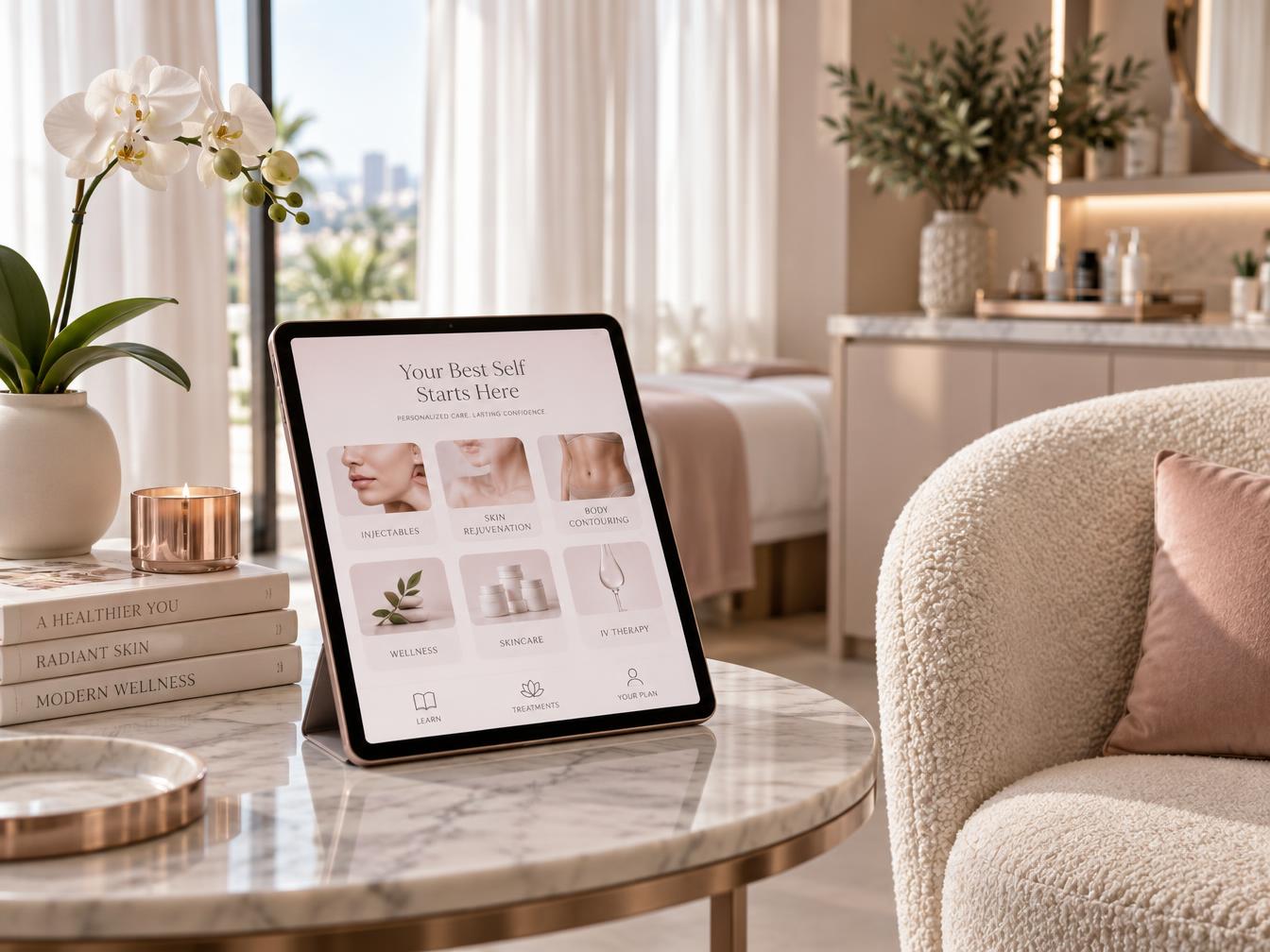
The classic version is a lobby TV looping the same reel all day. The modern version is interactive: a tablet in each room where the patient chooses what to explore. They browse your menu, watch short explanations, check price ranges, and tap a heart on anything that catches their interest.
That last part is what makes it marketing rather than just education. Every tap and every heart is a signal. When the provider enters the room, they can see what the patient explored and saved — so the conversation starts at 'tell me more about what you looked at' instead of a cold pitch.
- The patient explores at their own pace — nobody is selling to them.
- The practice learns what each patient is curious about, automatically.
- The provider walks in with context instead of starting from zero.
Why it outperforms traditional channels
Every other channel fights for attention somewhere else: an inbox, a social feed, a billboard. Point-of-care marketing has no competition for attention — the patient is sitting in a quiet room, waiting, phone fatigue already setting in. It is the one moment in their week when learning about your treatments is the most interesting thing available.
It also reaches the only audience with a near-perfect conversion profile: people who already trust you enough to be your patient. Acquiring a brand-new patient through ads costs real money. Expanding what an existing patient books costs almost nothing.
- Email open rates hover near 20%. In-room engagement reaches the patients actually in front of you — 100% of them.
- Ad clicks come from strangers. In-room interest comes from people who already booked.
- Interest expressed in the room converts to a conversation minutes later, not weeks later.
Which practices benefit the most
Any practice where patients wait alone benefits, but the return is largest where a wide menu meets a narrow booking pattern. Med spas see it when a neurotoxin regular discovers skin treatments. Dermatology practices see it when a medical patient discovers the cosmetic side of the practice. Plastic surgery offices see it when a consult patient arrives already understanding candidacy, downtime, and cost.
- Med spas: cross-service discovery drives add-on revenue from patients you already have.
- Dermatology: medical visits become a comfortable, patient-led bridge to cosmetic services.
- Plastic surgery: better-prepared consults, more realistic expectations, less explaining from scratch.
- Wellness practices: education builds the understanding that keeps patients committed to a plan.
How to start without overcomplicating it
Start smaller than you think. The practices that succeed with point-of-care marketing do not launch with a hundred pieces of content — they launch with their ten most-booked services and improve from real patient behavior.
- Put a tablet in every room a patient waits alone in, not just the lobby.
- Write one clear page per service: what it is, who it helps, price range, downtime.
- Make pricing honest. Hidden pricing ends the conversation before it starts.
- Let patients save what interests them, and make sure the provider sees that list.
- Review the interest data weekly and feature what patients actually tap on.
How to know it is working
Three numbers tell the whole story: how many patients interacted, how many saved at least one service they had not booked, and how many of those turned into a booked treatment within 90 days. The third number is your point-of-care conversion rate — and because the patients and the rooms are already yours, a single incremental treatment per month typically covers the entire cost.
clear answers
frequently asked questions.
Is point-of-care marketing the same as digital signage?+
No. Digital signage broadcasts the same loop to everyone and learns nothing. Point-of-care marketing is interactive: the patient chooses what to explore, and those choices become data the provider can use in the consult.
Does point-of-care marketing feel pushy to patients?+
Not when the patient is in control. It reads as service, not sales, when the patient chooses what to open at their own pace — the same way a good menu works in a restaurant. Interruption is what feels pushy; choice never does.
What does point-of-care marketing cost?+
A dedicated platform like Aesthetic Kiosk runs $299 per location per month, month to month. Because the audience is patients you already have, one incremental treatment a month usually covers it several times over.
How is this different from a patient portal?+
A patient portal handles logistics — forms, results, appointments — and patients use it at home, reluctantly. Point-of-care marketing handles discovery and education, and patients use it in your rooms, voluntarily, in the minutes before the consult.