
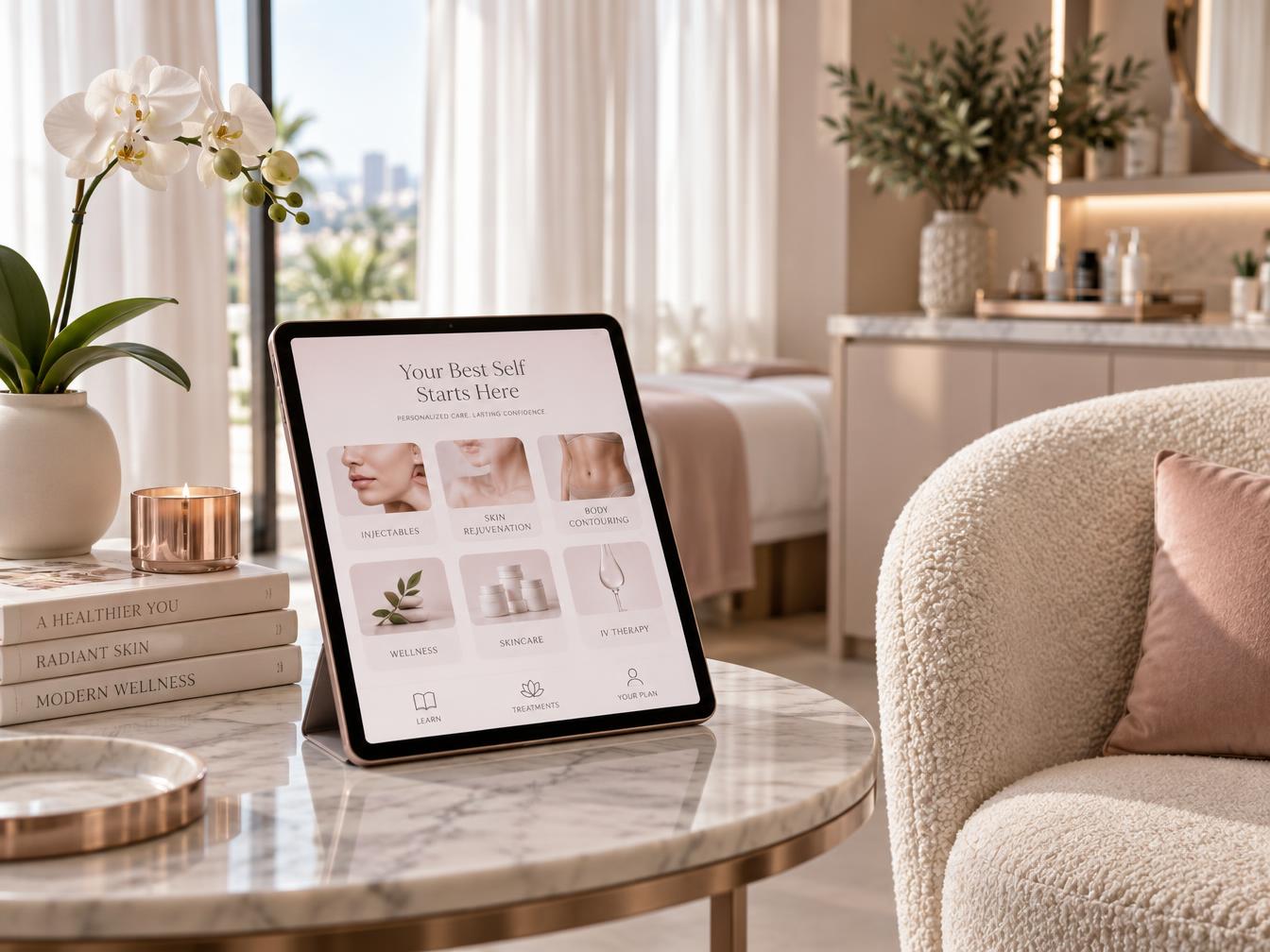
The best patient education does not interrupt the visit. It makes the conversation that follows more useful.
What point-of-care education actually means
Point-of-care education is information delivered while the patient is physically in your care environment: the waiting room, consult room, treatment chair, or checkout area. It is different from education found at home, which may be inaccurate, competitor-owned, or disconnected from your practice's voice and menu.
In an aesthetic practice, the useful questions are specific: how neurotoxins and fillers differ, what laser resurfacing feels like, whether microneedling has downtime, and how much a series costs. Patients may not ask these questions unprompted, but they will tap, watch, and save answers when the information is placed in front of them.
The most undervalued minutes in your practice
Aesthetic patients often spend 5 to 20 minutes waiting for a provider. In many practices, that time is silent or filled with generic television. Those minutes are not a scheduling failure to hide. They are focused attention from someone already inside your business.
When a patient browses your service menu during that window, they learn your language, discover treatments they did not know you offered, and form preferences before the provider enters. The consult becomes a conversation about what they already want to understand, not a cold pitch.
- Use the waiting window to answer the first layer of common treatment questions.
- Let patients choose the topics instead of forcing one message on everyone.
- Carry what they viewed and hearted into the consultation.
What the research says
Evidence for in-clinic education is broad and consistent across specialties. Informed patients ask better questions, make clearer choices, and report greater confidence in care decisions.
A systematic review of waiting-room education found that video and tablet experiences improved patient knowledge and prompted patients to raise topics with providers. Decision-aid research likewise shows that people become better informed and clearer about what matters to them when they face treatment choices.
From education to revenue
Education creates revenue only when it connects to action. A poster cannot capture intent, and a television loop cannot tell a provider what interested one patient. The value appears when browsing becomes a signal the provider can use.
In Aesthetic Kiosk, every tap and heart is tied to the current patient session. When the provider enters their PIN, they see what interested that patient. That handoff turns education into consultation preparation and gives the patient an easier way to begin the conversation.
The ROI calculator on our site lets a practice model its own treatment value and expected discoveries. With a fixed monthly cost and existing patient traffic, even a small number of additional bookings can make the economics easy to understand.
Interactive education is different from a passive loop
Passive education, such as lobby television, posters, and brochures, can create awareness. But it treats every patient the same and produces no feedback loop.
Interactive education lets the patient drive. They choose a category, watch a video, compare before-and-after results, ask questions privately, and heart treatments they want to discuss. The choices themselves reveal useful intent.
- The patient controls the pace and topic.
- Every meaningful interaction can inform the provider.
- The content reflects your services, prices, results, and voice.
- The experience continues into a more relevant consultation.
How forward-thinking practices use it now
Practices place a tablet in the rooms where patients wait and let them browse. The provider enters a 4-digit PIN to unlock the patient's favorites before the consultation begins.
The result is a patient who is more educated, more confident, and better prepared to discuss a treatment plan. Providers spend less time repeating fundamentals and more time applying their expertise to the person in front of them.
published evidence
the research, at a glance.
+6–8%
lift when point-of-care joins the mix
ZS / Point of Care Marketing Association, 2024
909 studies
reviewed on waiting-room education
Health Education Research, Oxford
70–85%
of patients visit a waiting room yearly
Health Education Research, Oxford
RCT-proven
awareness rises with in-clinic video
BMC Health Services Research, 2024
Decision aids
raise knowledge and clarity
Cochrane Review CD001431
clear answers
frequently asked questions.
What is point-of-care patient education?+
It is health and treatment information delivered where care happens, such as the waiting room, consult room, or treatment chair, rather than before or after the visit.
Does patient education increase revenue?+
Education alone does not guarantee revenue, but it raises awareness and prompts patient-led questions. When that intent reaches the provider, practices have a clearer opportunity to discuss relevant additional services.
What is the difference between passive and interactive education?+
Passive education broadcasts the same message to everyone. Interactive education lets a patient choose a topic, which creates a useful signal that can be saved and brought into the consultation.
What content works best in an aesthetic practice?+
Short videos, before-and-after imagery, plain-language treatment explanations, expected downtime, and transparent pricing give patients the information they most often need.